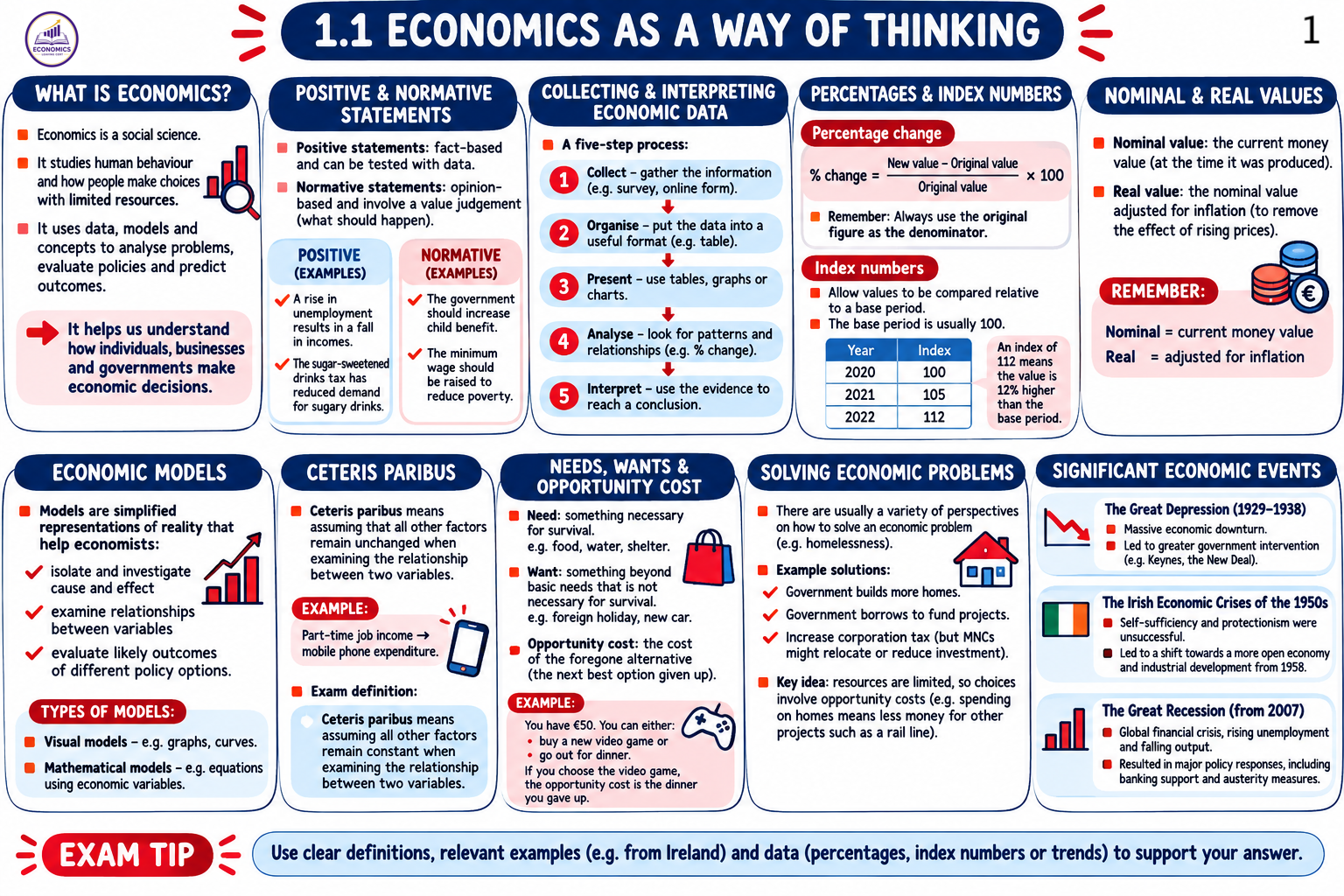
Economics as a way of thinking: choices, data, models and index numbers.
positive
normative
models
What is economics?
Economics is a social science. It studies human behaviour and how people make choices with limited resources.
It uses data, models and concepts to analyse problems, evaluate policies and predict outcomes.
It helps explain how individuals, businesses and governments make economic decisions.
Positive and normative statements
A positive statement is fact-based and can be tested with data. Example: a rise in unemployment results in a fall in incomes. Example: the sugar-sweetened drinks tax has reduced demand for sugary drinks.
A normative statement is opinion-based and involves a value judgement about what should happen. Example: the government should increase child benefit. Example: the minimum wage should be raised to reduce poverty.
Collecting and interpreting data
Collect: gather the information, for example from a survey or an online form.
Organise: put the data into a useful format, such as a table.
Present: use tables, graphs or charts.
Analyse: look for patterns and relationships, including a percentage change.
Interpret: use the evidence to reach a conclusion.
Percentages and index numbers
Percentage change = (new value − original value) ÷ original value × 100. Always use the original figure as the denominator.
An index number compares a value with a base period. The base period is usually 100.
An index of 112 means the value is 12% higher than the base period. Example: 2020 = 100, 2021 = 105, 2022 = 112.
Nominal and real values
Nominal value is the current money value at the time it was produced.
Real value is the nominal value adjusted for inflation, so rising prices are taken out.
Nominal = current money value. Real = adjusted for inflation.
Economic models
A model is a simplified representation of reality. It isolates and investigates cause and effect, examines relationships between variables, and evaluates likely outcomes of different policy options.
Visual models include graphs and curves. Mathematical models use equations with economic variables.
Ceteris paribus
Ceteris paribus means assuming all other factors remain unchanged while examining the relationship between two variables.
Example: part-time job income and mobile phone expenditure. Hold other spending constant so the link between those two can be seen.
Exam definition: ceteris paribus means assuming all other factors remain constant when examining the relationship between two variables.
Needs, wants and opportunity cost
A need is something necessary for survival, such as food, water and shelter.
A want is something beyond basic needs, such as a foreign holiday or a new car.
Opportunity cost is the cost of the foregone alternative: the next best option given up.
Example: you have €50 and can buy a new video game or go out for dinner. If you choose the video game, the opportunity cost is the dinner you gave up.
Solving economic problems
There is usually more than one view on how to solve an economic problem, such as homelessness.
Possible responses include the government building more homes, borrowing to fund projects, or raising corporation tax. A higher corporation tax may lead multinationals to relocate or reduce investment.
Resources are limited, so choices involve opportunity costs. Spending on homes means less money for other projects, such as a rail line.
Significant economic events
The Great Depression (1929–1938) was a massive downturn. It led to greater government intervention, including Keynes and the New Deal.
The Irish economic crises of the 1950s: self-sufficiency and protectionism were unsuccessful, and policy shifted towards a more open economy and industrial development from 1958.
The Great Recession from 2007 was a global financial crisis with rising unemployment and falling output. It brought major policy responses, including banking support and austerity.
Revision card
Economics
Economics
A social science that studies how people choose when resources are limited.
Positive statement
A fact-based claim that can be tested with data.
Normative statement
An opinion about what should happen. It includes a value judgement.
Ceteris paribus
All other factors held constant while two variables are examined.
Opportunity cost
The next best alternative given up when a choice is made.
Real value
A money value adjusted for inflation.
What you should be able to do
Appreciate the role of models, concepts and data for exploring economic behaviour, interactions, policy and outcomes
Differentiate between positive and normative economic statements; identify instances of their use in local, national or international media and economic commentary
Discuss and evaluate why solutions to economic problems may differ and how economic perspectives on solving economic challenges can change over time
Discuss how real world events such as the Great Depression, the Irish economic crises of the 1950s and the Great Recession (from 2007) have shaped our understanding of economics and the response of policy makers
Collect, organise, present, analyse and interpret data, with and without the use of technology, to come to an informed view and evaluate current economic issues and policies
Exam tip. Use a clear definition, a relevant example (Irish where you can) and a piece of data: a percentage, an index number or a trend.
Podcast
Question pack
8 marks
Distinguish a positive statement from a normative statement. Give one example of each.
A positive statement is fact-based and can be tested with data.
Example: a rise in unemployment results in a fall in incomes.
A normative statement is an opinion about what should happen and includes a value judgement.
Example: the government should increase child benefit.
10 marks
Explain ceteris paribus and opportunity cost. Use an example.
Ceteris paribus means all other factors are held constant while the relationship between two variables is examined.
Opportunity cost is the next best alternative given up.
Example: with €50 you can buy a video game or go out for dinner. If you buy the game, the opportunity cost is the dinner.
Hold other spending constant (ceteris paribus) so that choice can be examined on its own.