Scarcity, opportunity cost, the factors of production and the PPF.
scarcity
opportunity cost
PPF
Scarcity and the basic economic problem
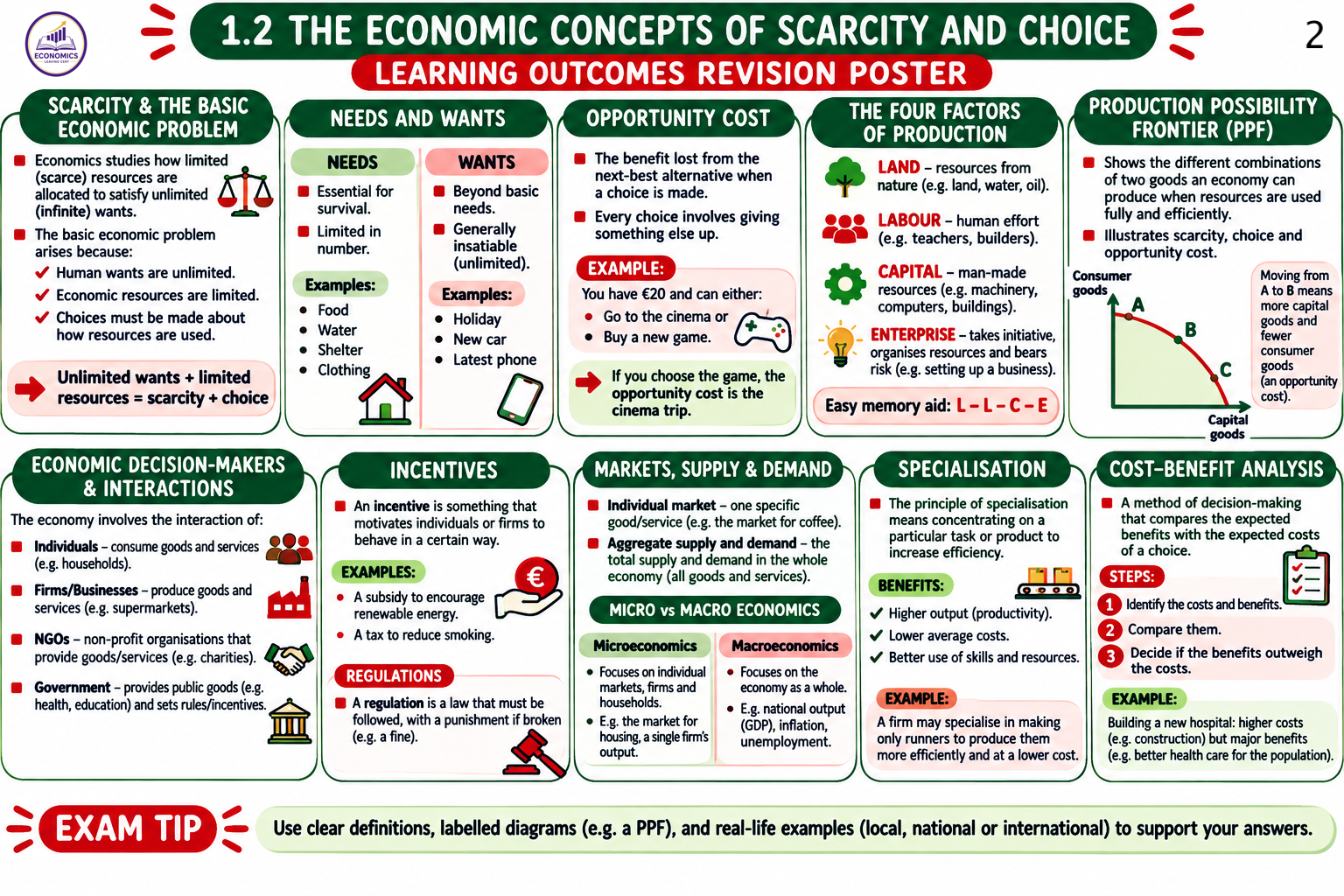
Economics studies how limited (scarce) resources are allocated to satisfy unlimited (infinite) wants.
The basic economic problem exists because human wants are unlimited, economic resources are limited, and choices must be made about how resources are used.
Unlimited wants plus limited resources equals scarcity and choice.
Needs and wants
Needs are essential for survival, limited in number: food, water, shelter and clothing.
Wants are beyond basic needs and are generally insatiable, so they are unlimited: a holiday, a new car or the latest phone.
Opportunity cost
Opportunity cost is the benefit lost from the next-best alternative when a choice is made.
Every choice involves giving something else up.
Example: you have €20 and can either go to the cinema or buy a new game. If you choose the game, the opportunity cost is the cinema trip.
The four factors of production
Land: resources from nature, such as land, water and oil.
Labour: human effort, such as teachers and builders.
Capital: man-made resources, such as machinery, computers and buildings.
Enterprise: takes the initiative, organises the other resources and bears the risk, for example by setting up a business.
Memory aid: L-L-C-E.
The production possibility frontier
A PPF shows the different combinations of two goods an economy can produce when resources are used fully and efficiently.
It illustrates scarcity, choice and opportunity cost.
Moving from point A to point B means more capital goods and fewer consumer goods. That fall in consumer goods is the opportunity cost.
Decision-makers, incentives and regulation
Individuals consume goods and services, for example households.
Firms and businesses produce goods and services, for example supermarkets.
NGOs are non-profit organisations that provide goods or services, such as charities.
Government provides public goods such as health and education, and sets rules and incentives.
An incentive motivates individuals or firms to behave in a certain way. A subsidy can encourage renewable energy. A tax can reduce smoking.
A regulation is a law that must be followed, with a punishment if it is broken, such as a fine.
Markets, supply and demand
An individual market is one specific good or service, such as the market for coffee.
Aggregate supply and demand is the total supply and demand in the whole economy, for all goods and services.
Microeconomics and macroeconomics
Microeconomics focuses on individual markets, firms and households. Example: the market for housing, or one firm's output.
Macroeconomics focuses on the economy as a whole. Examples: national output (GDP), inflation and unemployment.
Specialisation
Specialisation means concentrating on a particular task or product to increase efficiency.
Benefits: higher output (productivity), lower average costs, and better use of skills and resources.
Example: a firm may specialise in making only runners so it can produce them more efficiently and at a lower cost.
Cost-benefit analysis
Cost-benefit analysis compares the expected benefits of a choice with the expected costs.
Steps: identify the costs and benefits, compare them, then decide if the benefits outweigh the costs.
Example: building a new hospital has high construction costs but major benefits in health care for the population.
Revision card
Scarcity and Choice
Scarcity
Limited resources cannot satisfy unlimited wants, so choices must be made.
Opportunity cost
The next-best alternative given up when a choice is made.
Factors of production
Land, labour, capital and enterprise. Memory aid: L-L-C-E.
PPF
A curve showing the maximum combinations of two goods from fully used resources.
Specialisation
Concentrating on one task or product to raise efficiency and cut average cost.
Incentive
Something that motivates a person or firm to behave in a certain way.
What you should be able to do
Explain how scarcity of economic resources relative to wants results in choices being made between competing uses of resources; predict possible consequences of these choices
Explain how individuals, firms, businesses, non-governmental organisations (NGOs) and the government interact to produce, consume and distribute economic resources
Evaluate the opportunity costs involved in economic decisions made by individuals, firms and the government at local and national levels
Discuss the role of incentives and the motivating influences for individuals, firms, the business sector and the government in economic decisions; describe conflicting incentives with reference to local, national or international examples
Differentiate between individual markets and aggregate supply and demand; explain the difference in focus between micro and macro economics
Explain the principle of specialisation and outline how it may apply to individuals and firms seeking to increase efficiency
Analyse how a cost-benefit approach supports effective decision-making; apply a cost-benefit approach to assess who enjoys the benefits and who bears the costs
Exam tip. Use a clear definition, a labelled diagram such as a PPF, and a real example, local, national or international.
Podcast
Question pack
8 marks
Explain scarcity and opportunity cost, using an example.
Scarcity means resources are limited while wants are unlimited, so a choice has to be made.
Opportunity cost is the next-best alternative given up.
Example: with €20 you can go to the cinema or buy a game. Choosing the game means the cinema trip is the opportunity cost.
A PPF shows the same idea for an economy: more of one good means less of the other.
10 marks
Name the four factors of production and state the reward of each.
Land: natural resources, rewarded by rent.
Labour: human effort, rewarded by wages.
Capital: man-made resources such as machinery, rewarded by interest.
Enterprise: organises the other factors and takes the risk, rewarded by profit.